
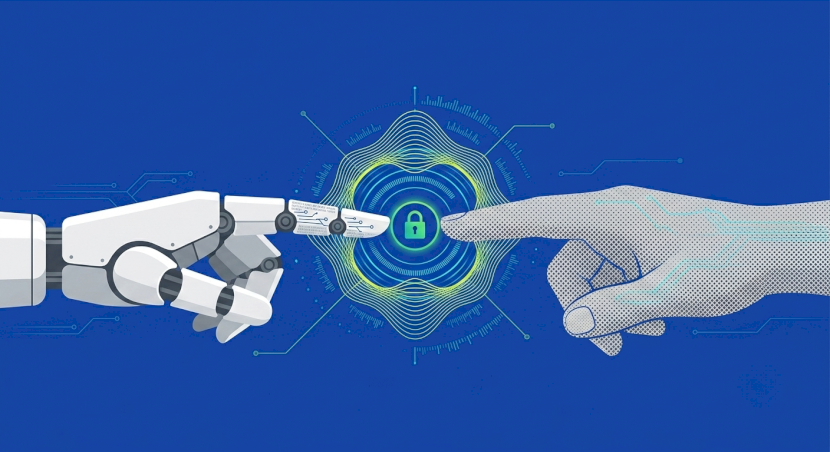
Is Your Company Using Artificial Intelligence Safely?
Artificial intelligence (AI) has become an everyday work tool in just a few short years. It is used to write emails, draft documents, analyze data, generate ideas, and automate various processes. Many companies already use AI tools like ChatGPT, Microsoft Copilot, Google Gemini, and others in their daily operations.
However, alongside new opportunities come new security risks. Often, the greatest challenge is not the technology itself, but how employees use it.
As Jānis Eglītis, Head of Service / Cybersecurity Manager at Baltijas Informācijas Tehnoloģijas, points out:
"When asking business leaders – is AI being used in your company? – the answer is usually unclear. Employees are definitely using these tools, but company culture and guidelines for these processes are most often undefined. Without a technical restriction on using internal company documents in AI tools, there is a real risk that an employee will submit them to these systems for research and analysis, most likely without realizing the risks involved. Everyone is drawn to the opportunity to work better, more efficiently, and get everyday tasks done faster. This is where a subtle, unnoticed risk creeps in – one that we must address by educating not only employees but any everyday user of tech products."
Artificial Intelligence: Not Just Efficiency, but a Security Risk
Most publicly available generative AI tools are designed to make the user’s daily life as easy as possible. However, when entering information into them, employees do not always stop to think about what happens to this data next.
Internal company documents, customer data, draft agreements, financial metrics, or even proprietary software code represent sensitive information. This data should never be shared with public AI tools without 100% certainty regarding their data processing and storage terms – otherwise, there is a risk that this data will be used for model training and end up in the public domain. Therefore, it is vital for companies to understand that AI usage is not just a productivity issue – it is a critical component of cybersecurity and corporate data protection.
Now, as the EU Artificial Intelligence Act (EU AI Act) gradually comes into force and the strict requirements of the General Data Protection Regulation (GDPR) remain active, secure AI governance in a company is no longer just a recommendation, but a legal obligation.
Common Mistakes in Corporate AI Usage
Even though technology evolves rapidly, the mistakes made in the workplace remain similar and are linked to three main areas: data security, content control, and tool oversight.
- Entering confidential data into public AI tools: Passing sensitive company or customer information to free AI tools whose privacy policies do not guarantee data isolation.
- Blind trust and AI "hallucinations": Relying on AI-generated information without verification. Generative AI is designed to always provide a convincing answer; therefore, when it lacks data, it tends to "hallucinate" – inventing and presenting completely false information with absolute confidence.
- Uncontrolled tool usage: A lack of guidelines within the company, resulting in employees using unverified, unapproved, and potentially dangerous tools for work purposes.
Technology is merely a tool, which is why the primary responsibility for information security and the validity of business decisions remains firmly with company management and its employees.
How Can a Company Implement Safe AI Practices?
Using AI safely does not mean banning the tools. On the contrary, it means establishing a controlled and thoughtful process that protects company data and confidential information.
- Develop a clear AI usage policy: Define which data employees are allowed to share with AI systems and which are strictly off-limits (for example, restrict the upload of customer data and internal financial reports).
- Educate your employees: Regular training on cyber hygiene and secure prompting will help employees understand the risks. It is important to emphasize that the main risk lies not in whether a tool is free or paid, but in the specific platform's data processing and privacy terms.
- Choose business-grade solutions: Wherever possible, opt for enterprise-level solutions. For example, systems like ChatGPT Enterprise, Microsoft 365 Copilot, and Google Workspace with Gemini contractually guarantee that your data will not be used to train public models and will remain within your company’s closed environment.
- Utilize safer technologies to mitigate risks: To minimize the risk of hallucinations, prioritize tools that support data grounding with sources (known as RAG – Retrieval-Augmented Generation technology) or offer built-in fact-checking with real-time references.
- Regularly review your practices: Technology changes rapidly, so the company's IT and security team must regularly audit the tools in use and adapt internal policies to meet new security standards and regulatory requirements.
Artificial intelligence is an excellent assistant that can save time, boost creativity, and ease daily routines. However, it cannot replace human critical thinking, experience, contextual understanding, and moral responsibility. Clear guidelines, employee education, and a responsible approach are the most effective ways to fully leverage the benefits of AI while keeping company data secure.